
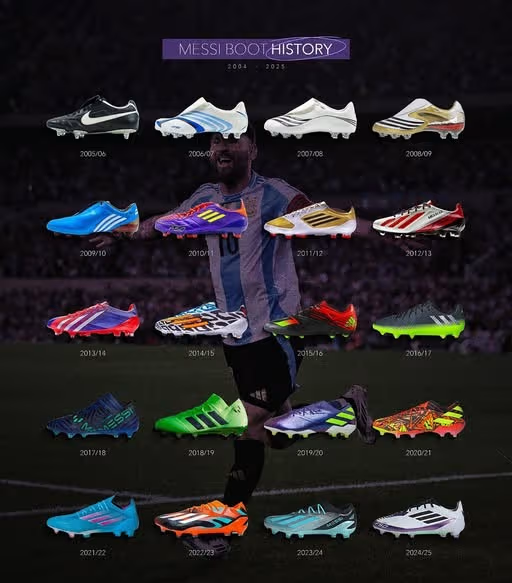
The trajectory of modern football is etched directly into the pitch by the boot prints of Lionel Messi. Over a glittering two-decade span, the Argentine maestro has transformed the sport through a blend of subterranean center-of-gravity balance, telepathic vision, and an unmatched technical wizardry. Every dropping of the shoulder, every iconic chip, and every historic trophy lift has been visually defined by the footwear engineered specifically to handle his logic-defying low-amplitude agility.
Behind this unparalleled on-pitch legacy lies one of the most lucrative and culturally significant brand partnerships in sports history. In February 2006, adidas secured Messi’s signature, pulling him away from rivals Nike in a foundational coup. This alliance culminated in 2017 when the German sportswear titan signed Messi to an unprecedented lifetime contract—valued at an estimated $1 billion—comprising unique profit-sharing agreements and an autonomous sub-brand ecosystem. The deal mirrors the structural scale of Michael Jordan’s relationship with Nike, anchoring adidas’ global football strategy entirely around the “M-Logo” empire.
For tactical purists, boot collectors, and football enthusiasts, Messi’s footwear catalog represents the absolute pinnacle of high-performance boot engineering. From the highly customizable modular concepts of the mid-2000s to the stripped-back, micro-synthetic speed silos of 2026, his equipment timeline serves as a blueprint for modern footwear innovation. This is the definitive, exhaustive chronicle of the tools engineered for football’s greatest technician.
Lionel Messi Football Boots Collection: The Early Years: Blueprints of a Prodigy
Before becoming the sovereign focal point of adidas’ global marketing strategy, a teenage Lionel Messi navigated his early Barcelona breakthrough wearing off-the-shelf speed and control silos. Upon signing his baseline adidas agreement in early 2006, the brand immediately inserted him into their premium speed category: the F50 line.
The young iconoclast quickly developed highly specific hardware preferences. While the mainstream market was pushed toward modular, interchangeable component systems, Messi’s feedback forced the factory at Herzogenaurach to construct highly customized, fixed-sole variations disguised as commercial models to accommodate his demanding raw acceleration and sharp, multi-directional cutting style.
| Item/Model Name | Release/Worn Year | Milestone Moment | Design & Details |
| Nike Air Zoom T90 III | 2004–2005 | Senior Professional Debut vs. Espanyol (Oct 2004) | White/Gold colorway featuring the distinct asymmetrical loop lacing system and Zoom Air heel pod cushioning. |
| Nike Air Legend / Mercurial | 2005 | First Official Senior Goal vs. Albacete (May 2005) | Soft K-leather upper with a traditional fold-over tongue, transitioning briefly into the lightweight synthetic Mercurial Vapor II matrix. |
| adidas +F50+ Spyder | 2006 | Post-Nike Legal Dispute Brand Switch | First official boot worn under the three-stripes banner; featured a distinctive spiderweb-like structural cage across the upper. |
| adidas +F50.6 Tunit | 2006 | 2006 FIFA World Cup Debut (Germany) | Commemorative White/Cyan colorway; commercially featured interchangeable studs, chassis, and uppers, though Messi used custom modifications. |
Lionel Messi Football Boots Collection
The Revolution & Dominance Era (The Deep Dives)
The Catalyst of the Sextuple: adidas F50i Tunit “Cyan” (2009)
As Pep Guardiola re-engineered Barcelona into an unstoppable, short-passing Tiki-Taka collective, Messi ascended to absolute global supremacy. The F50i represented the ultimate maturation of the modular Tunit era, utilizing a heavily streamlined upper profile designed to shed weight and drastically maximize clean ball-striking area.
The Design
A striking “Cyan Blue” base palette dominated the silhouette, accented by metallic silver structural lines flowing along the instep. The design incorporated a semi-translucent TPU (thermoplastic polyurethane) heel element that gave the illusion of a floating rear chassis. Custom touches included the Argentine Sun of May subtly embedded into the medial side, visually connecting Messi’s domestic club ascent to his international identity.
Groundbreaking Technology
- Sprintskin Upper: A revolutionary single-layer synthetic material measuring under 1.5mm in thickness, engineered to drastically reduce water absorption while maintaining a barefoot-like touch.
- Thermo-Bonded Lace Cover: An integrated shroud stretching over the instep, removing asymmetrical structural interruptions to provide a completely uniform striking surface.
- Custom Fixed Sole-Plate conversion: Unlike commercial models utilizing the modular Tunit system (which added bulk via threaded stud chassis), Messi’s player-issued variants featured a bespoke, lightweight, fully glued construction with a fixed Traxion stud layout.
The Rome Factory Secret
While amateur players wrestled with the complex wrench system to swap out soft-ground and firm-ground studs on commercial F50i models, adidas technicians created an entirely hidden specification for Messi. His pair utilized a lower-tier F30 chassis disguised via graphic wraps to look like an F50i, stripped of the internal modular bedding to keep the boot closer to the grass and significantly lighter than any retail counterpart.
Legendary Milestone Moments
Messi wore the F50i Cyan during the 2009 UEFA Champions League Final in Rome against Manchester United. In the 70th minute, he rose to meet an Xavi cross, looping an iconic header over Edwin van der Sar. As he landed, his right boot unseated itself; Messi instinctively scooped up the F50i and sprinted to the corner flag, kissing the sole plate in front of the global cameras—an image that instantly became one of the most effective organic marketing moments in footwear history.
The Legacy and Remakes
The F50i remains a holy grail silhouette for modern collectors due to its direct association with Messi’s first Ballon d’Or and the historic continental treble. It laid the structural groundwork for completely eliminating excess layers, shifting adidas’ design philosophy toward pure weight reduction.
The Apex Speed King: adidas F50 adiZero “Chameleon Purple” (2010)
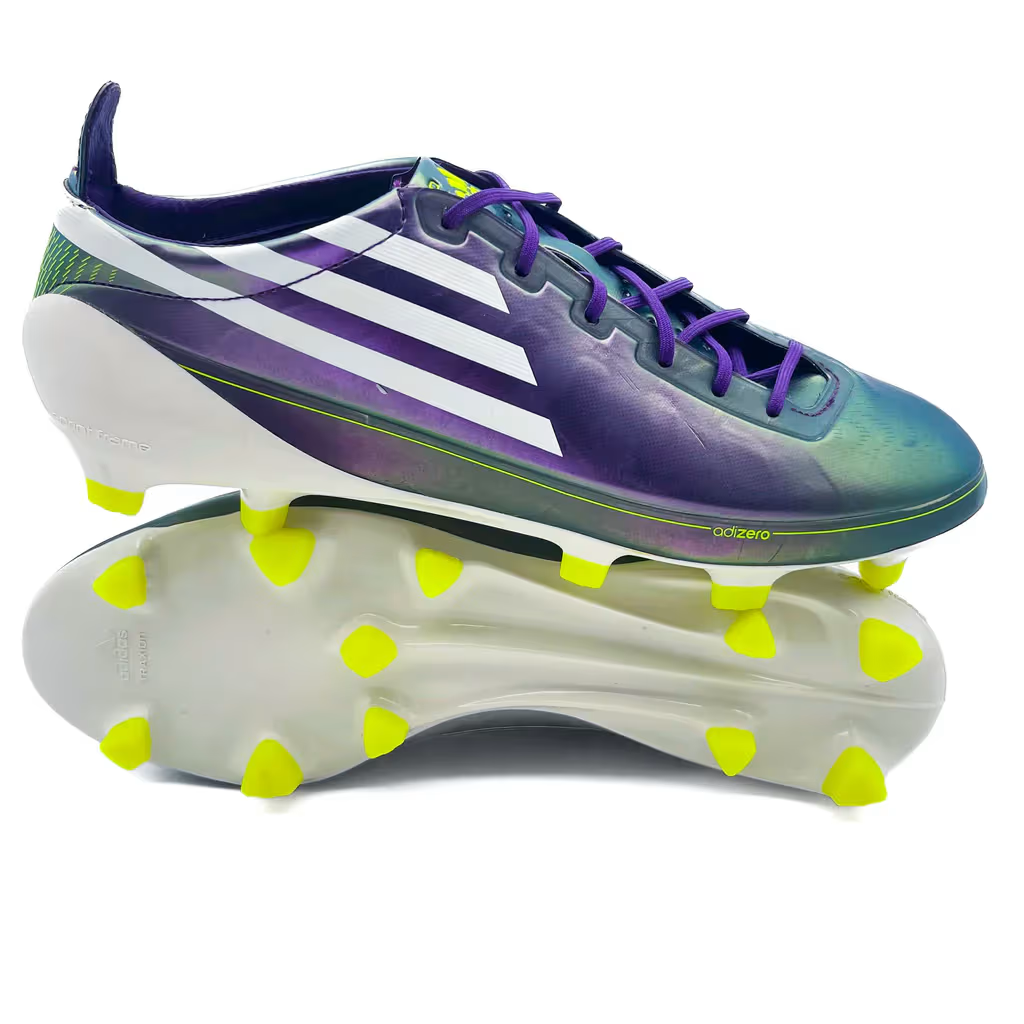
Entering the 2010 World Cup in South Africa, the football gear market was locked in a brutal weight war. Adidas dropped a nuclear option with the launch of the original F50 adiZero, a staggering engineering feat that shattered weight expectations and set a new benchmark for speed boots.
The Design
The launch colorway was a visually disruptive iridescent “Chameleon Purple” that shifted hues from deep violet to metallic blue depending on the angle of stadium lighting. This was contrasted with high-visibility yellow accents across the iconic three stripes and the ultra-minimalist external heel counter, designed to cause a blur effect when moving at high sprint velocities.
Groundbreaking Technology
- Aero-Dynamic Outsole (SprintFrame): A geometrically engineered, ultra-thin nylon chassis that utilized structural ribs to keep the plate rigid while reducing total boot weight down to a mind-boggling 165 grams.
- Dual-Upper Options: Offered commercially in both premium Taurus calfskin leather and a micrograin synthetic called Sprintskin, allowing players to choose between raw natural dampening or absolute weight reduction.
- Bespoke Last Architecture: Built on a completely revised, hyper-contoured foot last that locked the foot directly over the sole plate, minimizing internal energy loss during explosive lateral cuts.
The Custom K-Leather Mandate
Despite adidas heavily marketing the high-tech synthetic variant of the Chameleon adiZero, Messi adamantly refused to play in it. The Herzogenaurach factory had to carefully apply the Chameleon Purple shifting graphic pattern onto premium, ultra-soft kangaroo leather uppers specifically for him, combining old-school artisanal touch with modern, space-age visual cosmetics.
Legendary Milestone Moments
While worn at the 2010 World Cup, this boot dominated the domestic 2010–2011 campaign. Wearing the Chameleon adiZero, Messi put on an absolute masterclass in the UEFA Champions League semi-final at the Santiago Bernabéu, slicing through the entire Real Madrid defense to score a historic solo goal that cemented his march toward a third consecutive Ballon d’Or.
The Legacy and Remakes
The 2010 adiZero is universally regarded as one of the greatest speed boots ever constructed. Adidas has continuously honored this specific silo, releasing a limited-edition remake package engineered with modern carbon-fiber tooling to celebrate its enduring influence on modern speed design.
Taping the Magician: adidas Nemeziz Messi 19.1 “Balón d’Or Pack” (2019)

By 2019, Messi’s game had subtly shifted from pure touchline sprinting to an elite, deep-lying creative orchestrator. To support this evolutionary shift, adidas introduced the Nemeziz line—a radical concept designed around the principles of medical tape compression and absolute anatomical lockdown.
The Design
To celebrate Messi claiming an unprecedented sixth Ballon d’Or, adidas issued an ultra-exclusive, premium edition of the Nemeziz 19.1. The boot featured a pristine white elasticated upper wrapped in gleaming, reflective metallic-gold graphics detailing his career statistics. The split-sole plate was treated with a full chrome-dipped gold finish that mirrored the sheen of the Ballon d’Or trophy itself.
Groundbreaking Technology
- Tension Tape Matrix: An upper completely constructed from interconnected elasticated bandages inspired by ritualistic pre-match sports taping, providing a 360-degree adaptive fit that dynamically expanded and contracted with the foot’s muscular movement.
- Agility Bandage System: Replaced traditional rigid internal structural cages, delivering a highly personalized midfoot lockdown without creating structural pressure points or restricting natural articulation.
- Split Torsion System Outsole: A modular, decoupled two-piece sole-plate design that maximizes torsional flexibility through the midfoot arch, allowing the forefoot and heel to operate independently during rapid changes of direction.
The Gamified Lacing Preference
While adidas heavily promoted the laceless Nemeziz + model as the premium tier of their agility lineup, Messi’s structural preferences dictated a strictly laced setup. His player-issued 19.1 variants featured a deeply customized eyelet construction built directly into the Tension Tape seams, ensuring he could manually tighten the midfoot wrap to his exact millimeter requirements.
Legendary Milestone Moments
Laced into this golden silhouette, Messi completely dominated La Liga defenses throughout late 2019, scoring a succession of signature free-kicks and edge-of-the-box curlers. The model served as a visual crown, celebrating his status as the sport’s ultimate individual record-breaker.
The Legacy and Remakes
The Nemeziz 19.1 pushed the concept of textile-based football boots to its absolute limit. It remains an incredibly distinct structural oddity within Messi’s boot archive, highly sought after by collectors due to the intricate career-stat typography layout woven directly into the synthetic bandage layers.
The Storytelling Series: Narrative Through Gear
Throughout their historic partnership, adidas has used Messi’s signature boots as a canvas for biographical storytelling. These special-edition chapters have cataloged his journey from the streets of Rosario to global immortality.
Chapter 1: adidas F50 adiZero “Rosario” (2014)
- The Story: This release paid direct homage to Messi’s childhood roots in Rosario, Argentina, drawing visual inspiration from the graffiti-lined brick streets and the concrete pitches of his youth club, Grandoli.
- The Design: A vibrant solar orange and vivid pink split upper, overlaid with intricate, urban-style vector graphics mimicking local street art. His son Thiago’s name and birthdate were explicitly laser-etched onto the lateral heel counter.
- The Tech: Constructed on the generation-four F50 adiZero chassis, utilizing a hybrid synthetic Speedtraxion stud configuration engineered specifically to increase high-speed turning traction on firm ground surfaces.
Chapter 2: adidas Messi 15.1 “Platinum” (2016)
- The Story: Designed exclusively to honor Messi becoming the first player in football history to claim five Ballon d’Or trophies, shifting his signature line out of general speed silos into a fully autonomous signature product category.
- The Design: A minimalist, clean, pearlescent white upper utilizing genuine platinum metallic flakes embedded into the material matrix. The rear synthetic cage featured a debossed premium leather texturing embossed with the phrase “El más grande de todos los tiempos” (The Greatest of All Time).
- The Tech: Introduced the revolutionary messiFRAME—an external, 3D-molded plastic skeleton cage that locked the heel and midfoot securely to the plate, paired with a custom forefoot stud layout dubbed messiPRINT.
The Modern Era & The 2026 “Last Dance”
Now lighting up North American soccer landscapes with Inter Miami CF, Lionel Messi’s technical requirements remain as hyper-specific as they were during his European peak. In 2026, he continues to operate as the undisputed centerpiece of the revived adidas F50 lineage.
Current Gear Choices & Custom Specifications
On any given matchday in 2026, Messi steps onto the pitch wearing a highly modified variant of the adidas F50 Elite. While the external aesthetics match the general commercial release, his personal boots are crafted in Germany inside the specialized Athlete Services facility. His current loadout includes:
- An ultra-soft, custom-stitched natural leather toe-box seamlessly fused to a lightweight synthetic midfoot matrix.
- A fully modified, rounded stud profile that slightly replaces the razor-sharp commercial traction blades, reducing stress on his knee joints during pivots.
- An asymmetrical, traditional low-cut tongue construction that foregoes the elastic compression collar favored by younger speed athletes.
The 2026 Masterpiece Remakes
To celebrate the 20-year evolution of this historic partnership, adidas has unleashed a dual-pronged retro-modern release schedule in early 2026, seamlessly blending nostalgic visuals with contemporary sole-plate technology.
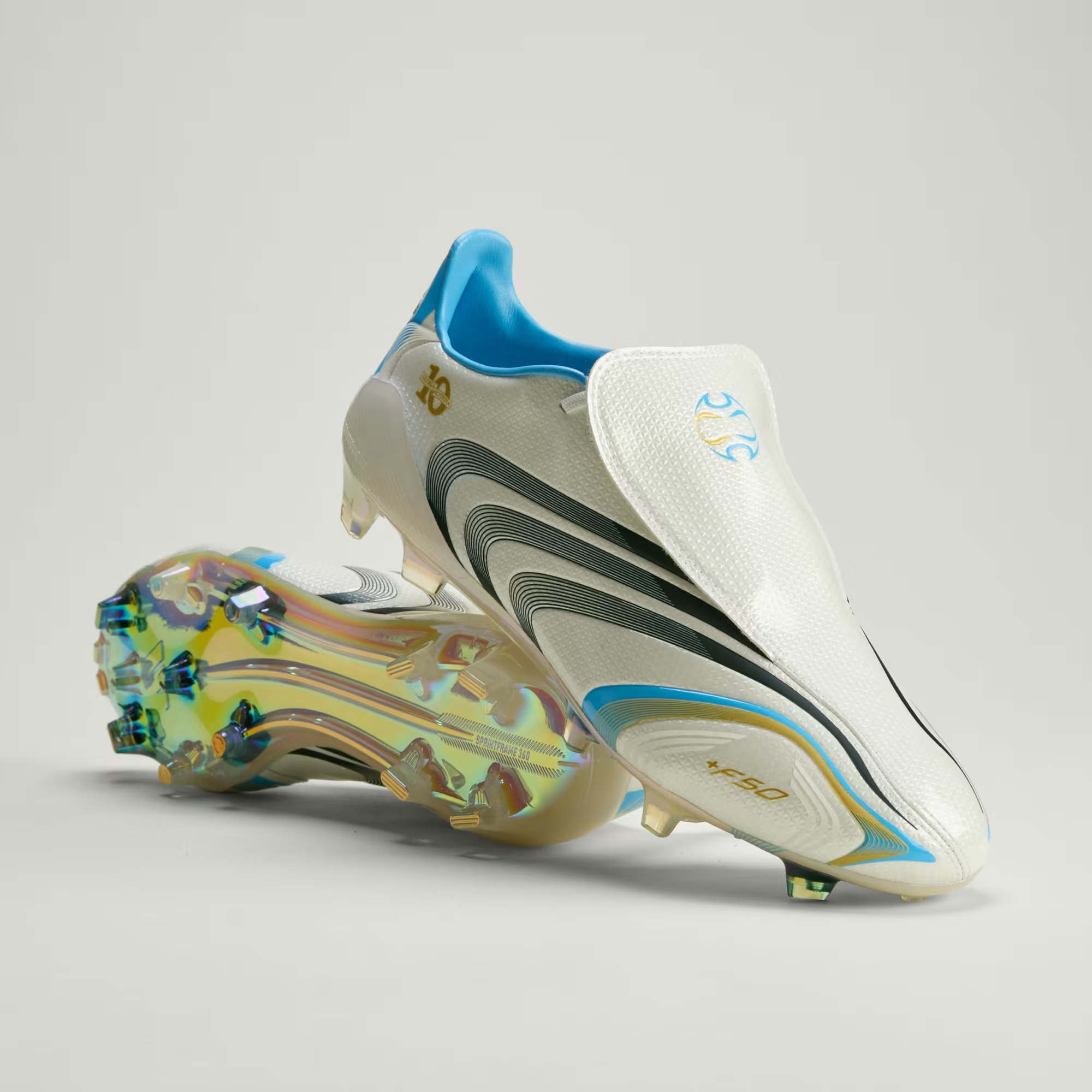
The Nostalgia Fusion: adidas F50.6 Tunit “Argentina 2006” Remake (2026)
- Release Window: January 2026
- The Blueprint: A magnificent modern recreation of the iconic boots worn during his 2006 World Cup debut in Germany. The upper features the unmistakable crisp white leather base accented by sweeping, deep-gray curved wave ridges along the lateral flank and brilliant cyan-blue highlights tracing the heel counter.
- Modern Enhancements: While the upper evokes pure 2006 nostalgia, the internal structure strips away the heavy modular bolt-on stud components of the past. It replaces them with a permanent, high-performance 2026 AeroPlate outsole. The heel area is intricately embellished with three stars honoring Argentina’s World Cup titles, the legendary number 10 typography, and the historical match dates (“25.06.78”, “29.06.86”, “18.12.22”) laser-etched directly into the inner lace tracking.
The Crown Jewel: adidas F50 Messi “Hora Dorada” (2026)
- Release Window: April 2026
- The Design: Translating literally to the “Golden Hour,” this signature boot celebrates the sunset phase of his historic career. The colorway is a deep metallic gold and champagne fusion that honors his early-career Barcelona kit accents while retaining a high-tech chrome sheen across the chassis.
- The Tech: Features a highly responsive carbon-fiber spine embedded into the midfoot plate, engineered to maximize energy return during his short, explosive bursts of acceleration inside the penalty box.
The Upcoming “Last Dance” Final Edition
As rumors circulate within the footballing community regarding Messi’s final international milestones, collectors and design historians are already tracking whispers out of Herzogenaurach regarding a definitive “Last Dance” Final Edition boot.
Industry insiders indicate this upcoming masterpiece will feature an unprecedented full-matrix holographic upper that subtly transitions between the structural layouts of his four most iconic boots: the 2006 Tunit, the 2009 Rome F50i, the 2014 World Cup Battle Pack, and the 2022 Lusail World Cup-winning Leyenda. It’s a wearable archive—the final physical mark on a 20-year partnership that permanently transformed football footwear.